Getting Around Bangkok: BTS, MRT, Grab, and When to Take a Tuk-Tuk
Reviewed for accuracy on Jan 13, 2026
The single biggest improvement to your Bangkok trip comes from understanding the transport network in the first 24 hours. The city has six legitimate ways to get around and they each shine in different conditions. Pick the right one for the right ride and you'll glide through. Pick wrong — most commonly, by Grab during the 4-7 PM gridlock — and you'll lose hours.
Here's how I think about it after five trips.
The BTS Skytrain (your primary tool)
The elevated train system that runs the length of Sukhumvit and crosses through Siam, Silom, and out to the river. Clean, fast, air-conditioned, and the best way to move along its lines. There are now multiple lines (the Sukhumvit and Silom lines are the originals; the Gold Line extends to ICONSIAM; extensions keep being added).
When to use it: Any trip that runs along Sukhumvit Road, between Sukhumvit and Silom, or from central Bangkok to the river at Saphan Taksin. About 60-70% of my Bangkok rides are on the BTS.
Fares: Distance-based, around 17-62 baht per trip. Buy a Rabbit Card on day one — refillable, works on the BTS, faster than fumbling for change at the gate.
Operating hours: Roughly 6 AM to midnight. After midnight you're in Grab territory.
Limits: It doesn't reach the Old City temples. It doesn't reach Khao San. The map shows it goes more places than it actually does — many "extension" stations are still being built.
The MRT subway
The underground subway, separate from BTS but connecting at Asok/Sukhumvit, Silom/Sala Daeng, and Mo Chit/Chatuchak Park. The MRT covers Chatuchak, Hua Lamphong (the old central station), and a different swath of the city than the BTS.
When to use it: Anything to Chatuchak Market, anything connecting to Hua Lamphong, or trips through the eastern and western parts of the central city the BTS doesn't reach.
Fares: Similar to BTS, around 17-70 baht. Separate card system from the BTS — confusingly, your Rabbit Card doesn't work on MRT and vice versa. They're working on it.
In practice, I plan trips on the BTS first and only fall back to MRT for specific destinations.
Grab (the Southeast Asian Uber)
Grab is the rideshare app that replaced the chaos of haggling with Bangkok taxi drivers. Download it before you arrive, link a credit card, use it constantly. The app shows the price up front, you don't negotiate, and the driver takes the meter route or the app's suggested route.
When to use it:
- Any trip the BTS/MRT doesn't cover
- Late-night rides after the trains stop
- Any trip with luggage
- Any trip where you don't want to deal with directions
- Any trip with kids or a stroller
When NOT to use it: Between 4 PM and 7:30 PM in central Bangkok if your destination is on the train. You will sit in traffic. A 15-minute ride at noon becomes 50 minutes at 5 PM. The BTS goes the same speed at every hour. Take the train.
Fares: Variable, but roughly 80-200 baht for most central-city trips. Surge pricing kicks in during rain and rush hour.
Tips: GrabBike (motorbike taxi) is faster than a car in heavy traffic but only worth it if you're traveling alone, light, and not bothered by helmet-and-no-airbag transit. I take it sometimes, but I recommend it cautiously.
Bangkok metered taxis
Bright pink, yellow-green, blue, or orange cars marked "TAXI-METER." They still exist and they're fine. The trick is the meter. Drivers are required to use it; many will refuse and offer a flat rate that's worse for you. Ask "meter, please." If the driver refuses, get out and grab the next one. Or just use Grab.
Fare: 35 baht for the first 1 km, then around 6.50 baht/km. A 20-minute ride should run 80-150 baht.
I generally only take metered taxis when I can't get a Grab match in less than five minutes (rare), or when I'm flagging from a place with no app reception. Both are edge cases.
The Chao Phraya river boats
Underrated. The river is a working transit corridor and the boats are real public transit, not just sightseeing. Multiple lines:
- Orange flag (local boat): Cheap (15-25 baht), stops at every pier, can be packed at rush hour but the most authentic ride. This is what locals use.
- Blue flag (tourist boat): 200 baht for an unlimited day pass. Stops at the major tourist piers (Sathorn, ICONSIAM, Tha Tien for Wat Pho/Wat Arun, Phra Athit for Khao San). English announcements. The right choice for a sightseeing day on the river.
- Cross-river ferries: Around 5 baht per crossing. Use these instead of Grab when you need to cross the river — most notably between Tha Tien and Wat Arun.
- Long-tail boats: Private hire for canal tours. Negotiate the price up front (around 1,000-1,500 baht for a 90-minute tour) and skip the operators near the touristy piers in favor of the smaller ones further upriver.
When to use them: Any trip that runs along or across the Chao Phraya. Wat Pho to Wat Arun. Sathorn to ICONSIAM. Anywhere along the river. Faster than Grab during peak hours, more pleasant than the train, cooler than walking.
Tuk-tuks (the honest truth)
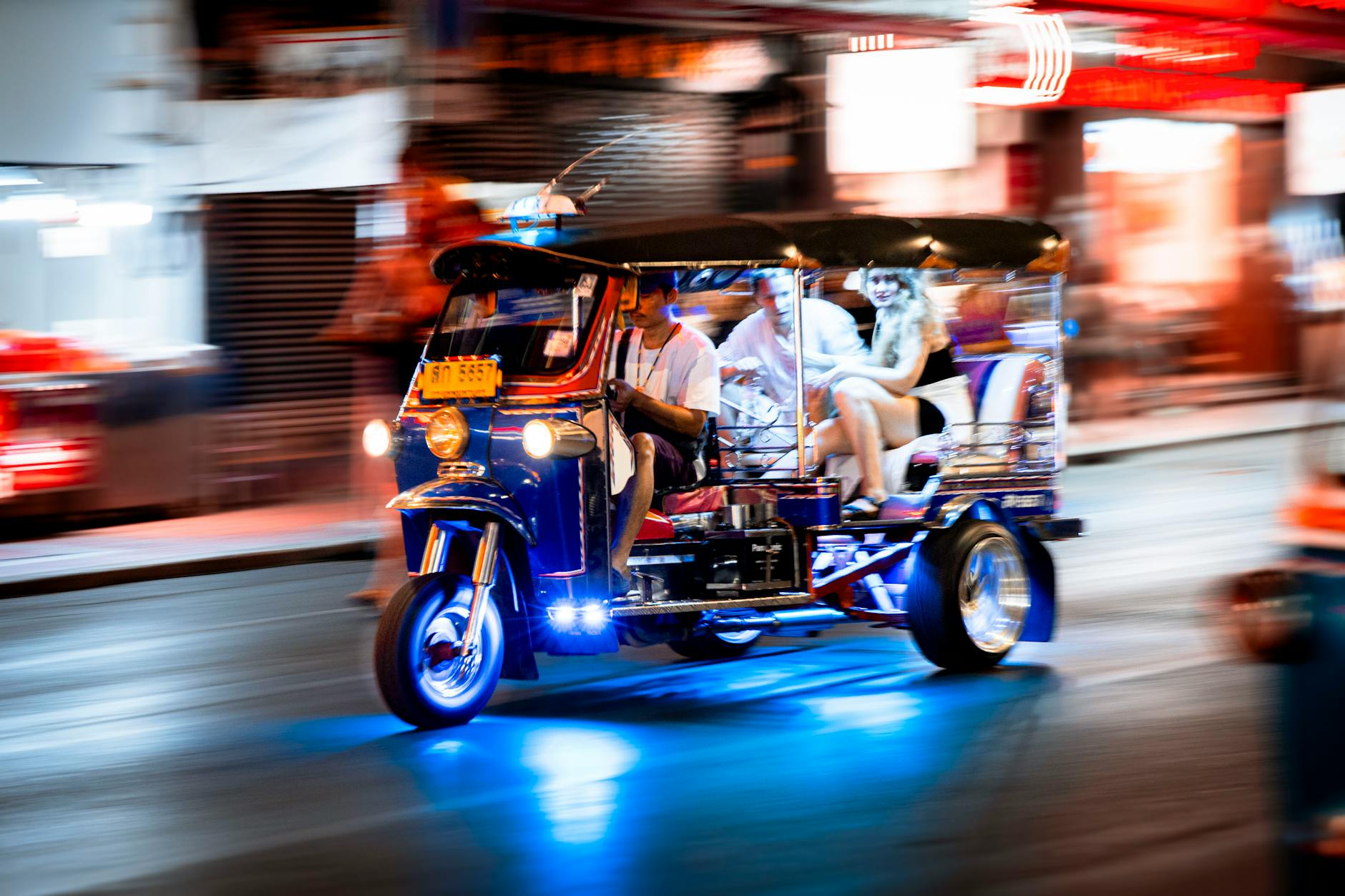
Tuk-tuks are largely a tourist novelty now. They were once the city's workhorse three-wheeled transit; the BTS, MRT, and Grab have eaten their lunch. What's left is mostly a tourist experience.
When to take one: Once. For the experience. A short ride between two nearby places. You'll sit in the back, the engine will roar, the driver will weave through traffic, you'll inhale exhaust, and you'll either love it or hate it.
What to know: Tuk-tuk drivers will often offer wildly low prices ("100 baht for the whole afternoon!"). The catch is they'll insist on stopping at one or two "shops" — usually gem dealers or tailors — where they get a commission. You can refuse, but you'll feel awkward. Just pay the fair price for a direct ride (around 100-150 baht for a short hop).
The dishonest ones: A common scam is the driver who tells you the temple you're going to is closed for a "special holiday" and offers to take you somewhere else instead. The temple is not closed. Walk past them and into the actual entrance.
I've taken maybe four tuk-tuk rides in five trips to Bangkok. Once for the experience, three times when nothing else made sense. They are not a transit strategy.
Walking
Bangkok is hard to walk. The sidewalks are uneven, there are open drains, the heat is brutal between 10 AM and 4 PM, and the crossings on the major arteries are sparse. That said, walking through specific neighborhoods is how you discover the city.
Walk these: the side sois off Sukhumvit (Soi 24, 26, 33, 38, 39, 55), the alleys around Wat Pho and Tha Tien, Chinatown's Yaowarat at night, the back streets of Banglamphu near Khao San, the riverbank promenade between ICONSIAM and the Sathorn Pier.
Don't walk: along major arteries like Sukhumvit Road itself, anything in midday heat, anything with kids beyond a few blocks.
A neighborhood-by-neighborhood transit cheat sheet
- Sukhumvit (your hotel): BTS for everything along the road. Grab for everything else.
- Old City / Grand Palace area: Grab in, river boat or ferry within. Avoid Grab during evening rush.
- Chinatown (Yaowarat): MRT to Hua Lamphong or Wat Mangkon, then walk.
- Khao San / Banglamphu: Grab in or river boat to Phra Athit pier.
- Riverside hotels: River boats and BTS Saphan Taksin.
- Chatuchak Market: MRT to Kamphaeng Phet or BTS to Mo Chit.
Airport transit
From Suvarnabhumi (the main international airport):
- Airport Rail Link: 45 baht to Phaya Thai BTS, around 30 minutes. Fast, cheap, easy. The right choice if you have manageable luggage and your hotel is near a BTS station.
- Grab or metered taxi: Around 350-450 baht to central Bangkok including the airport surcharge. The right choice if you have heavy luggage or a small group.
From Don Mueang (the secondary airport, mostly low-cost flights):
- Bus or van to a BTS station (slower) or Grab (around 350 baht).
A few rules I've learned
- Plan around the 4-7 PM rush. Don't put a Grab-required appointment in that window.
- Save 30 minutes of buffer on every transit estimate. Bangkok is unpredictable.
- The BTS is air-conditioned and clean enough to wait in for 10 minutes if it's raining. Don't run for a closing door.
- Topping up Rabbit Card and MRT card balances at machines is the fastest way through the gates. Keep at least 100 baht on each.
- Always have a small amount of cash for boat fares and tuk-tuks. They don't take cards.
What I'd do differently
On my first trip I used Grab for everything because I knew the app already. By trip two I'd switched to BTS-first, Grab-second, and my time in transit dropped by about half. The locals know which ride works best for which trip. After a couple of days you'll know it too. Until then, default to the train.
For broader trip planning, the Bangkok travel guide covers neighborhoods and the city overall, and the 3-day itinerary puts this transit network into a real day-by-day plan.
Bring the trip home
Every photo on York Adventures is shot on location and available as a fine-art print. Browse the gallery to find a frame for your wall.
Stay in the Loop
Get new photos, stories & exclusive deals straight to your inbox.
Related Posts
Bangkok in 3 Days: My Tested Itinerary For First-Timers
A 3-day Bangkok itinerary I've refined across five trips — temples on day one, food and neighborhoods on day two, river and a sunset on day three. No fluff.
Bangkok Shopping: Markets vs Malls — Where to Spend Your Day
How Bangkok's markets and malls actually compare — Chatuchak versus EmQuartier, MBK versus ICONSIAM, and where to spend your shopping day depending on what you want.
Bangkok With Kids: A Family Travel Guide That Actually Works
Bangkok with kids isn't the chaos people expect — here's the neighborhood, schedule, and food strategy that makes it work, from someone who's done it twice.